
Arlington Previous Residents Sources
Arlington house history works best as a dated chain, not a single address search. The current assessor card establishes the parcel and owner-of-record snapshot. Middlesex South land records establish transfers. Directories, maps, census schedules, permits, newspapers, cemetery records, and probate then add the people and events that a deed alone cannot show. Older online name searching has gaps, so the Registry counter, book and property searches, and local-library collections remain important access routes.
| Source | Years It Covers | Where Held | What It Shows |
|---|---|---|---|
| Middlesex South land records | 1649-present, with uneven online indexing | MassLandRecords and Registry counter | Deeds, parties, legal descriptions, plans, and prior transfer references |
| Arlington assessment card | Current fiscal-year record | Town Assessor | Owner of record, situs, sale information, and parcel attributes |
| Arlington directories | 1869-70 through 1940, with gaps | Robbins Library, State Library, and digital collections | Residents, businesses, and street-list occupants |
| Sanborn and atlas maps | 1872-1951 holdings vary by series | Robbins Library and related map collections | Footprint, street context, construction, and lot development |
| Federal census | Released through 1950 | NARA, library, and genealogy access routes | Enumerated households, relationships, and address context |
| Arlington Advocate archive | 1871-2005 digitized range | Arlington newspaper archive | Notices, obituaries, civic references, and address mentions |
For recent changes, begin with the parcel card and the purchase deed. For a nineteenth- or early twentieth-century household, start with the directory street list and map, then work back to the deed and census. The sources often overlap, but their dates do not.
Arlington Parcel Cards First
The Arlington Assessor is the current starting point for previous residents research. Its WebPro property search is described as supporting street, owner, neighborhood, style, lot-size, sale, year-built, and bedroom searches. Record the situs address, parcel or property identifier, current owner, sale date, and any legal-description or book-page lead. The assessor identifies an owner of record as of January 1 of the fiscal year, so it is an assessment snapshot rather than a guaranteed same-day ownership statement.
Keep situs and mailing address separate in the research notes. Situs means the physical Arlington parcel. A mailing address is only the tax-correspondence destination and can belong to an agent, a trust contact, or someone elsewhere. Neither field establishes a full household. A parcel identifier is useful as a lookup key, but the research did not verify one universal Arlington format.
- Grantor
- The party transferring an interest in a deed, often the seller in an ordinary purchase transaction.
- Grantee
- The party receiving that interest, often the buyer whose prior purchase can lead to an earlier deed.
- Chain of title
- A sequence of linked transfers for the same land. It is ownership evidence, not a complete occupancy history.
- Legal description
- The lot, plan, boundary, or prior-instrument wording that ties older land records to a parcel when a street address changes.
Note: Capture the search date with every assessor result because ownership, values, and portal displays can change.
Arlington Deed Index Access
After identifying the parcel, use MassLandRecords Middlesex South rather than a general county-office search. Arlington belongs to the Middlesex South Registry District. Recorded Land offers Name, Document, Book, Property, Recorded Date, and Unindexed Property searches; Registered Land has related modes. Select Arlington before widening the party search. Search and image viewing are described as free, while older gaps and copies can require help from the Registry counter.
A current address may not appear in an old instrument. The stronger path is parcel card to legal description, book/page or document number, then the Registry detail. The Registry’s instructions note that broad results can be capped at the first 1,000 rows, so a town, date, party type, and document-type filter is more reliable than surname alone. If an online route stops, the Middlesex South Registry can assist with older indexes, book/page research, unindexed property, and copies.
Trace Previous Residents Through Middlesex Deeds
Follow the deed chain one transfer at a time. A purchase deed names the buyer as grantee and the seller as grantor. The legal description and prior-instrument reference are the anchors that make the backward trail safer than matching names alone.
- Find the current situs, owner-of-record, sale details, and parcel lead in Arlington WebPro.
- Open the buyer’s purchase deed in MassLandRecords using the Arlington town filter, party name, book/page, document, or property search.
- Record both parties, recording date, instrument number or book/page, legal description, and every prior deed reference.
- Search the seller’s earlier purchase as a grantee, then repeat the sequence with spelling variants and every named party.
- When a modern address fails, use Book, Property, Unindexed Property, plans, or the Registry counter with the legal description.
Mortgages and discharges can corroborate a period, but a discharge does not prove a sale. Plans can be decisive when an original lot became several houses or a subdivision changed the numbering. The trail remains a record of title, not proof that every deed party lived at the property.
Arlington Grantor Scans Online
There is a useful recent bridge for Arlington previous residents research. On October 21, 2025, the Registry announced that grantor-index scans for 1896-1973 had become available online. The Registry announcement expands an era that often required counter work, especially for a backward deed chain.
The improvement does not make the whole history a single name index. The Registry’s institutional records reach back to 1649, but the local house-history guidance describes the principal online grantor/grantee workflow as strongest from the 1970s forward. Earlier records can have gaps, old spellings, and address mismatches. Use the scans as one access channel, then switch to book/page, property search, plans, or the counter when needed.
A screenshot of the Middlesex South grantor-index expansion documents the newly available historical-index route.
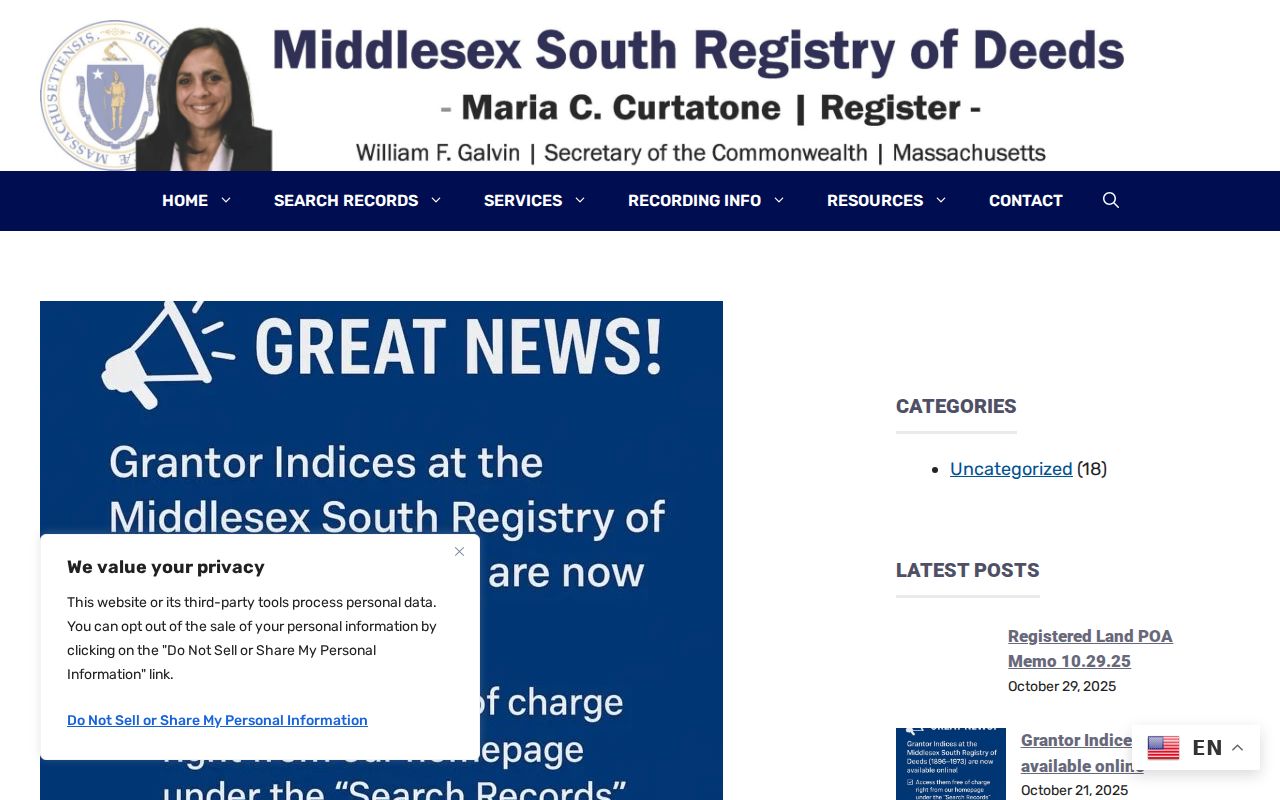
The release helps connect older grantor research to a remote search, while the deed image, legal description, and prior reference still need to be read together.
Arlington's 1935 Address Bridge
Arlington’s important address-history trap is the 1935 change in street names and numbers. The Arlington Historical Commission house-research guide directs researchers to a Center for Local History conversion table. A present-day number should not be substituted mechanically into a 1890 directory, deed, or map. Save the current form, find the older form in the conversion table, and compare surrounding streets, lot shape, plan references, and atlas or Sanborn evidence.
This is also why previous residents can seem to disappear between editions. A move is possible, but so are a renumbered street, a publisher’s timing gap, a spelling change, or a different historic place label. Search Arlington, West Cambridge, and Menotomy where the record era supports it. Arlington was renamed from West Cambridge in 1867, and older records may use the earlier names.
A capture of the local house-history guide shows the Arlington-specific route that connects deeds, directories, maps, and changed addresses.
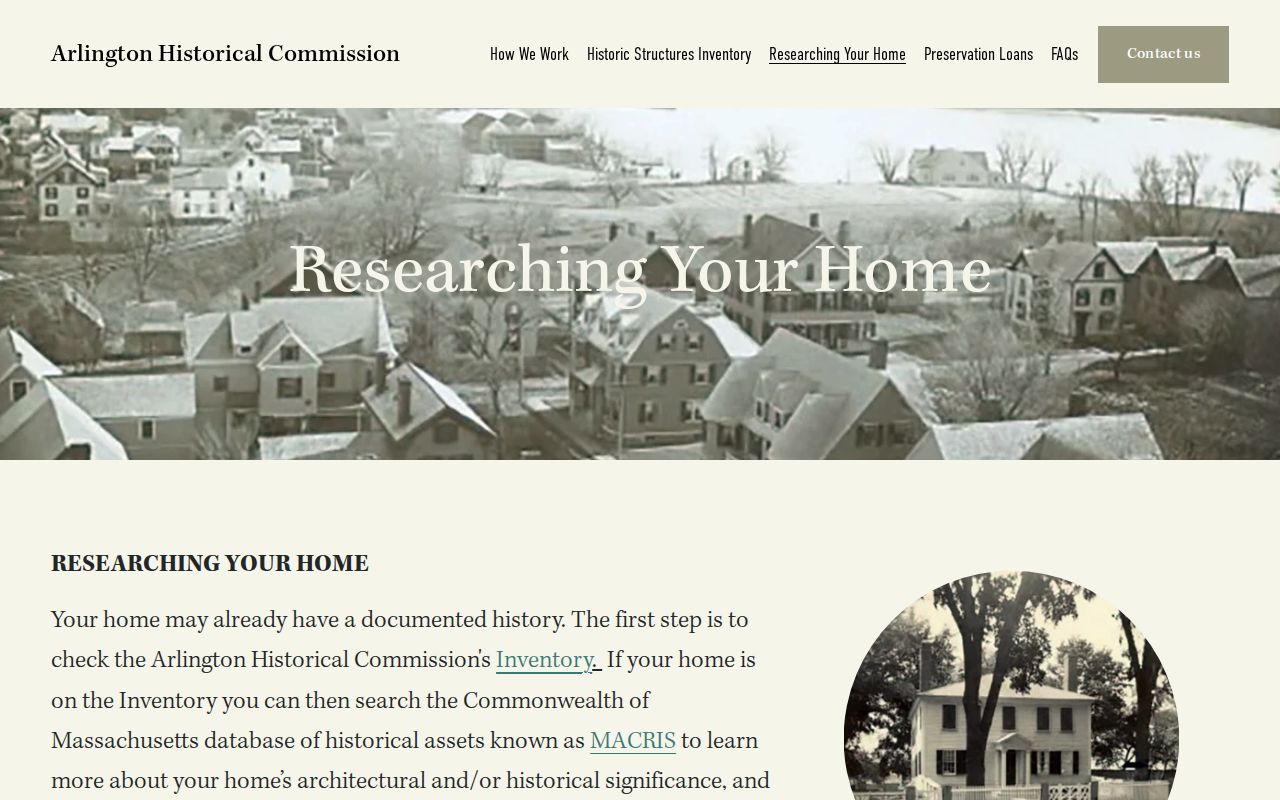
The conversion step prevents a false conclusion that an earlier household or deed is missing simply because the modern address label is different.
Arlington Previous Residents in Directories
Deeds identify the ownership trail. Arlington directories add the past-resident layer. Local and state holdings begin with 1869-70 and run through 1940 with gaps; directories from 1894 forward include street lists that can map a house number to an occupant or business. Search the surname list and street list separately. Preserve spelling, initials, street form, occupation, and page number before moving to the next available edition.
Pair the directory year with released census schedules, which are public through 1950 under the federal 72-year release rule. Then test what agrees across a directory, census, deed, newspaper notice, permit, or map. The fuller holdings and how an entry reads belong on the Arlington city directory page; here, their role is to test who lived at one address around a transfer date.
- Choose a directory before and after the known deed transfer.
- Compare the address in the street list with the surname entry and the historic address form.
- Check the closest released census year for household relationships and enumeration address.
- Use the Arlington Advocate for a dated notice, then verify event details through the appropriate custodian.
Note: OCR can misread initials and street abbreviations, so inspect the directory or newspaper image before treating text extraction as a transcription.
Arlington Buildings by Map
Sanborn maps and atlases date a building form, not a person. Arlington holdings include atlases from 1872, 1898, 1922, and 1923, and Sanborn years from 1885 through 1951 with local access varying. These maps can show footprint, stories, material, use, outbuildings, adjacent streets, and development context. Use them after the address-conversion step, especially when a lot was divided or a street was reconfigured.
Permit activity provides a much later chronology. Arlington publishes FY2024 through FY2026 building-permit spreadsheets, with monthly updates and separate one/two-family and commercial files. A permit can name an applicant, owner, or contractor where published, but it is not a resident list. Compare the permit date and work description with map and deed evidence rather than assigning occupancy from the name alone.
Arlington Past Residents Endpoints
When a past household leaves the directory trail, use a narrow endpoint search. The digitized Arlington Advocate covers 1871-2005 and can surface obituaries, notices, organizations, business references, and streets. Arlington cemetery records can add interment or plot context. For an estate question, Middlesex Probate and Family Court South-Woburn and MassCourts may provide a public docket, while sensitive files and addresses remain restricted.
Probate may identify a fiduciary or heir in a public matter, but an executor’s mailing address is not proof of the former owner’s residence. A directory can record a resident, a map can date the structure, and a probate docket can identify estate context. None should be stretched to answer all three questions.
Lawful use. Arlington previous-resident research belongs to family history, house history, and estate research. Do not use records to track, contact, threaten, or harass a living person, or to work around a protected address.