
Arlington City Directory Collection Runs
Arlington’s historical directory shelf begins with 1869-70 and continues through a local publisher sequence reaching 1940, with gaps. Robbins Library/Center for Local History, the Massachusetts State Library, and digitized Internet Archive material provide complementary routes. The State Library holdings list is a useful checklist for confirming a particular edition. A missing year should remain a documented gap, not become a claim that the family or address vanished.
| Collection | Years | Where held | Access |
|---|---|---|---|
| Arlington directories and Resident & Business Directories | 1869-70 through 1937 in listed runs; 1940 in local publisher history | Robbins Library, State Library, Internet Archive | Repository holdings and online scans; gaps between editions |
| Greenough, Jones & Co. directory | 1871-72 | State and local holdings | Somerville, Arlington, and Belmont title |
| Edward A. Jones directories | 1894, 1896, 1898, 1900, 1902-03, 1904-05 | Local and state holdings | Arlington and Belmont, then Resident and Business titles |
| Boston Suburban Book Co. | 1906, 1908, 1910 | Local and state holdings | Resident and Business Directory editions |
| Union Publishing / Lothrop’s Arlington | 1912-1940, with gaps | Local and state holdings | Later resident, business, and house-guide volumes |
| Digitized sample volumes | 1894, 1896, 1898, 1904, and other Robbins scans | Internet Archive Robbins Library collection | OCR-assisted scans; verify against the page image |
Federal holdings provide a second route for selected years. The National Archives city-directory holdings guidance lists Arlington volumes for 1930, 1933, and 1935, corroborating the local sequence.
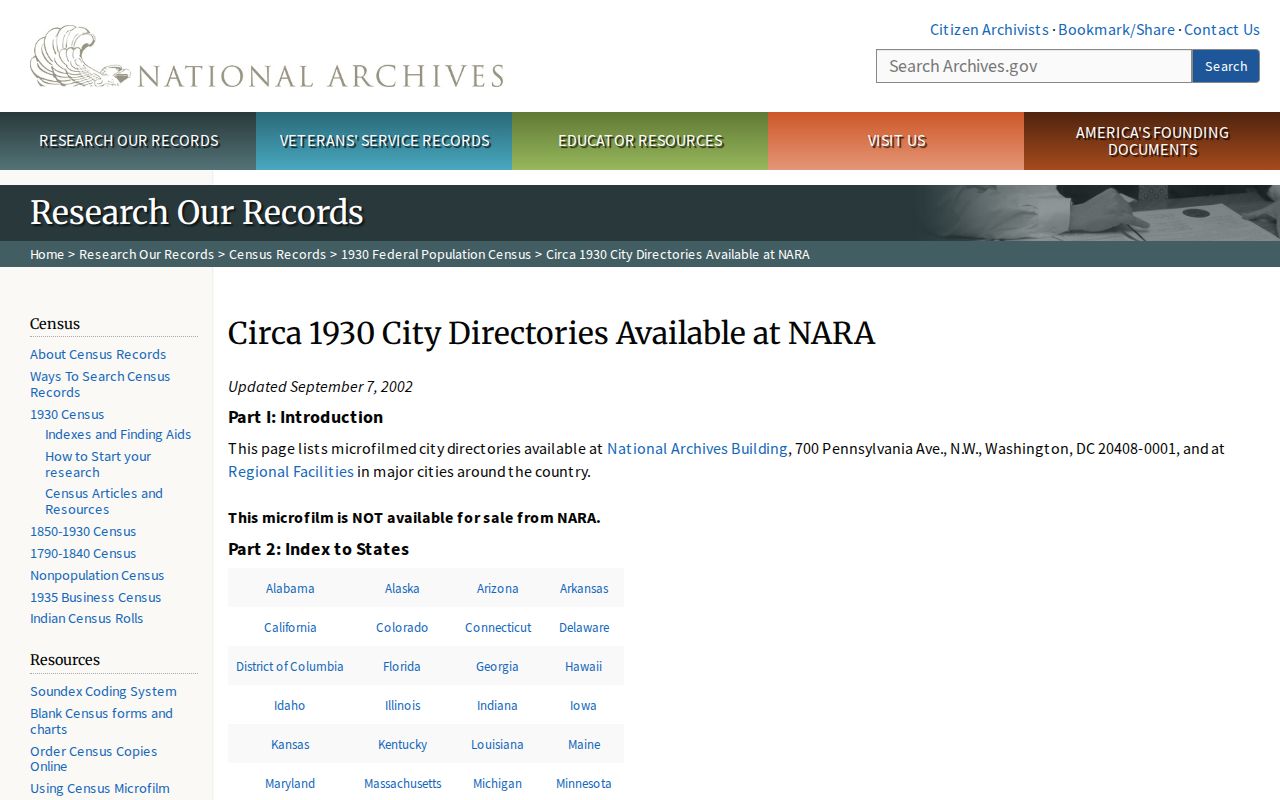
The federal listing helps locate a year, while the local volumes and page images provide the entry needed for a household trail.
Arlington Historical Directory Place Names
Search more than one place label in an Arlington historical directory collection. The place was Menotomy before it became West Cambridge, then took the Arlington name in 1867. Early entries can therefore sit under West Cambridge, and some volumes combine Arlington with Belmont or Somerville. Use the exact title printed on the volume as part of the citation.
The Massachusetts State Library directory and voting-list holdings provide the dated run to check against. Asterisked volumes in that list contain a House Guide, which can add address and property context beyond the surname pages. The research did not locate an official source for a regular modern printed Arlington directory after 1940, so the historical run should not be described as a current directory.
Reading an Arlington City Directory Entry
Read an entry as a publisher’s dated assertion. The 1898 scan and companion editions can show a surname, given name or initial, a street address, an occupation or business role, and a business address where the listing provides it. Spouse or household notation, street-list entries, and symbols may be present, but their meaning is edition-specific. Record the volume year and page before drawing a conclusion.
| Name | Surname plus given name or initial as printed, including the punctuation and spelling used in the edition. |
|---|---|
| Address | A street and number in a resident listing, or an address-order street-list entry that links a number to a listed person or business. |
| Occupation or role | A descriptive field that can distinguish people with the same name, but is not proof of any later activity. |
| Business detail | A business name or business address when that directory section supplies one. |
| Household notation | A spouse, widow, boarder, owner, or business-type symbol only when the edition defines it. |
| Source reference | The directory year, page, and page image used to check the transcription. |
- Street list
- The address-order part of a volume, which can locate listed occupants or businesses by house number.
- House Guide
- An added feature in some State Library-listed volumes that can supply address or property context beyond the name index.
- Abbreviation key
- The edition’s own explanation of symbols and shortened words. Photograph or note it before interpreting any mark.
- OCR
- Machine-readable text generated from a scan. It makes discovery quicker but can misread letters, initials, hyphens, and line breaks.
Arlington OCR for Historical Directories
OCR is a lead, not the record. Check every useful search result against the page image, especially for “rn” and “m,” initials, hyphenated surnames, street abbreviations, and West Cambridge references. A page may have been compiled months before it was printed. It does not, by itself, prove ownership, legal residence, citizenship, or every person in a household.
The digitized 1898 Arlington directory is a direct example of the image-first check.
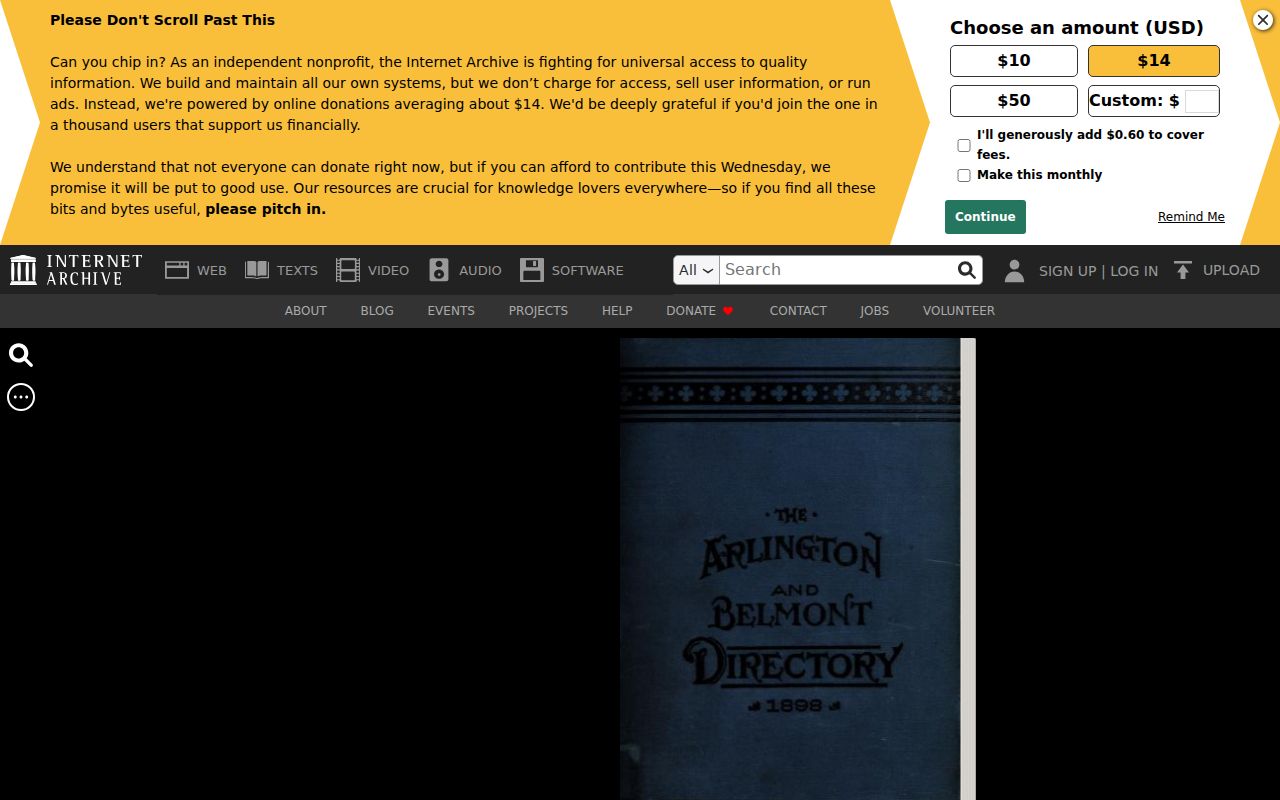
Use the scan to preserve the page and entry as printed, then compare the result with the prior and next available edition.
Tracing Arlington Directory Households
A household trail is strongest when each dated Arlington directory entry is compared with another record type. Preserve the street spelling, number, full name or initial, and any business detail without silently updating them. A person who disappears may have moved, died, married or changed a name, been missed by the compiler, or fallen into a publication gap.
- Find the surname and, separately, the street-list entry in the closest available edition. Record the exact volume year and page.
- Check the prior and next available directory year. Search an initial and a full first name, married or widowed forms, business name, and the Arlington or West Cambridge place label.
- Pair directory years with the released federal census. Census schedules through 1950 can provide household relationships, age, birthplace, occupation, and enumeration address under the federal 72-year release rule.
- For an address move, compare deeds, permits, maps, and the historical street-number conversion material before treating two addresses as different properties.
- For a disappearance, use obituary notices, cemetery or interment information, and probate where public access permits. A widow notation alone does not identify every heir.
For a modern parcel or current deed question, use the address-focused Arlington street directory workflow rather than trying to turn a historical entry into a current finding.
Arlington Directory Maps and Dates
Arlington’s maps explain many apparent directory breaks. Robbins Library local-history material includes atlases from 1872, 1898, 1922, and 1923, a 1933 zoning plan, and Sanborn map holdings. Sanborn editions in the research range from 1885 through 1951. They can show a footprint, construction material, use, outbuildings, and nearby streets, but not a person’s occupancy.
| 1867 | West Cambridge was renamed Arlington, creating an early search-term change. |
|---|---|
| 1869-70 | The first Arlington directory holding identified in the local and state run. |
| 1894 onward | Available directories include street lists, making address-to-listing research possible in those editions. |
| 1935 | A major original street-name and number change appears in the Center for Local History conversion-table lead. |
| 1940 | Local publisher history reaches this year, with gaps in the overall sequence and no verified regular modern printed run after it. |
Start from the current form only to find the parcel, then use the conversion table, a nearby atlas or Sanborn sheet, and both street forms in the historical volumes. Legal descriptions and lot shapes are more dependable than substituting a modern number into an older volume.
Arlington Directory Newspaper Context
The Arlington Advocate digital archive gives the directory trail a local newspaper companion. The research identifies Arlington Advocate coverage from 1871 through 2005 and related local titles, including News, Daily News, Press, and Enterprise. Search a surname with an address, street, organization, business, cemetery, or likely event date. Newspaper OCR can confuse Arlington place references, so inspect the published image and compare it with town details.
Obituary research works best as a chain: find a likely notice, verify it with Town Clerk death material or cemetery information, and use probate for a public estate or heir question. Town annual reports, available from 1842 in the Robbins Library archive, add municipal and place context. Individual structure or value detail is strongest after about 1870 and less consistent after about 1910.
Arlington Directory Research Referrals
Robbins Library and its Center for Local History are the main local gateway for directories, maps, Sanborns, annual reports, newspaper material, and the house-research conversion-table lead. The Internet Archive Robbins Library collection provides an online route for selected scans, while physical and state holdings fill gaps that a scan search may miss.
The Arlington Historical Society research page describes a different role. The Society holds artifacts, publications, and referral resources but does not state that it maintains a complete research library or archive. Its PastPerfect catalog can surface photographs, objects, people, places, and collection references. Ask the Library, government custodian, or map and archive holders for the actual record when a catalog lead needs verification.
The referral route can add local context to an entry without turning an artifact catalog into a complete name directory.
Use the access channel that fits the missing piece. Internet Archive scans can make a surname, street, or business search possible at home, but an OCR hit should be checked against the image. Robbins Library and the Center for Local History remain the local route for maps, reports, physical materials, and the address-conversion lead. The Massachusetts State Library holdings list helps identify an edition before a visit or request. For an event that appears only as a newspaper clue, the Arlington Advocate image, Town Clerk, cemetery office, probate registry, or Registry of Deeds may provide the next independent check. Preserve each collection name, volume year, page, and search date in the research record.